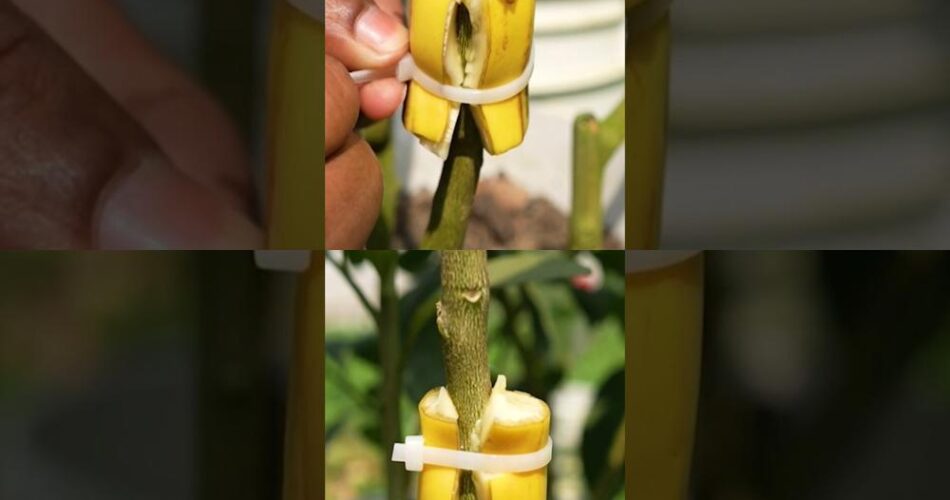
Impact of banana on the spread of lemon by aerial marcottage
Aerial marcottage is a method of vegetative propagation of plants that allows to reproduce an individual exactly identical to the original. This technique is widely used in horticulture to multiply plants from a parent. When it comes to propagation of different types of plants, the use of specific materials can have a significant impact on the success rate of the process. In the case of the lemon tree, the use of banana as an envelope for aerial marcottage is a common practice and can have notable advantages.
The advantages of using bananas for the aerial marcottage of the lemon tree
- Protection and hydration: Banana skin acts as a natural protection for the marcottage area by maintaining the moisture needed for root growth. This prevents dehydration of tissues and promotes healthy and robust rooting.
- Nutrients and Growth Hormones: Bananas are rich in essential nutrients such as potassium, magnesium and various vitamins. These elements promote root development and encourage the growth of new shoots. In addition, banana contains natural levels of growth hormones that can stimulate the root formation process.
- Economic and ecological: The use of banana skin as an envelope for aerial marcottage is an economical and environmentally friendly solution. This is a simple way to reuse potential organic waste as a resource beneficial to plants.
The stages of the aerial marcottage with banana envelope for the lemon tree
Here are the steps to be taken to achieve an efficient aerial marcottage with the banana envelope:
- Choose a healthy branch: Select a healthy and vigorous branch of the lemon tree to perform the aerial marcottage.
- Prepare the banana: Remove the flesh from the banana while keeping the skin intact. Cut it to the size necessary to wrap the marcottage area.
- Incose branch: Make a bevel incision on the selected branch and remove a thin layer of bark to promote root formation.
- Wrap with banana skin: Wrap the incised area with the banana skin by attaching it firmly to ensure close contact and maintain moisture.
- Monitor and water: Monitor the evolution of the marcottage regularly, ensuring adequate moisture is maintained. Water as needed to ensure root growth.
- Separate and Replant: Once sufficient roots have developed, separate the new plant from the parent branch and replant it in a suitable substrate.
In conclusion, the use of banana as an envelope for the aerial marcottage of the lemon tree has significant advantages by promoting root development and providing essential nutrients. This economic and ecological method can be an interesting option for gardeners wishing to multiply their lemon trees efficiently. By following the appropriate steps, it is possible to achieve satisfactory results and enjoy new healthy and vigorous plants.